The choices you make about your printing can significantly
impact your business at many levels: Your branding, your credibility, your
market share and, of course, your bottom line. Look at this inspiring story as
an example, where a middle school student created quite a buzz when he demonstrated
how the government could save a staggering $400 million by simply changing the
font of their printed documents.
Suvir Mirchandani, 14, first proposed the idea as a way for
his Pittsburgh school district to save some cash. But when he applied the
formula to state and federal government numbers, the middle schooler realized a
small change could reap a big reward.

Changing fonts from Times New Roman to Garamond on all
printed government documents would keep some serious cash in the coffers, the
science experiment by Suvir Mirchandani, 14, shows.
The middle schooler’s well-thought out plan shows that
Garamond, one of the oldest fonts around, is significantly thinner than the
default Times New Roman typeface, meaning a switch would provide significant
savings on ink — a pricey commodity.
“Ink is two times more expensive than French perfume by
volume,” the wise teen told CNN, pointing to the $38 cost of Chanel No. 5
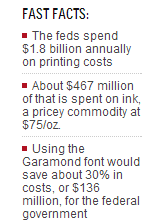
perfume and the $75 an ounce of Hewlett-Packard printer ink will set you back. The feds spend some $1.8 billion in printing costs annually,
and have tried double-sided printing and using recycled paper to cut costs. But
finding ways to save on annual ink costs of $467 million is a new frontier. Using Garamond would save some 30% on those costs, about
$136 million, while if local and state governments followed suit, about $234
million could be cut.
Suvir first conducted his font experiment on a smaller
level, looking at the possible savings within his school districts. When he discovered the change could lead to some $21,000 in
savings, he took it to the next level and looked at government costs. He submitted his startling findings to the Journal for
Emerging Investigators, a journal that publishes research by teens, and the
founders of which were blown away by the results.
“We were so impressed,” JEI’s Sarah Fankhauser told CNN. “We
really could really see the real-world application in Suvir's paper."
It’s unlikely the feds will take action on Suvir’s say so. A
spokesman for the Government Printing Office said efforts towards
sustainability have already begun — and as more content goes online, less
documents need printing.
"In 1994, we were producing 20,000 copies a day of both
the Federal Register and Congressional Record,” Gary Somerset told CNN. “Twenty
years later, we produce roughly 2,500 print copies a day.”
Suvir, though, says no matter what happens, some things will
need to be printed — and that making a change, even for less documents, remains
worthwhile.
"I recognize it's difficult to change someone's
behavior. That's the most difficult part,” he told CNN. “I definitely would
love to see some actual changes and I'd be happy to go as far as possible to
make that change possible.
As you can see, being innovative and thinking outside the
box can really pay off. Keep in touch and let us help you maximize the benefits
of your printing. Call 877.990.1616 or visit us on the web
www.marketinkgroup.com