Showing posts with label printing. Show all posts

Thursday, May 15, 2014

The prettier side of PMS


Everybody knows what PMS is, right? Well, that is if you are thinking of the syndrome that many women experience every month with their cycle. But few people know the other meaning of PMS, one that professionals in the world of design and printing must deal with everyday, only this kind of PMS is pretty and fun. We are referring to Pantone, a system for matching colors used in specifying printing inks, hence the term PMS = Pantone Matching System. We hope you find this information useful to help you understand the colorful details of Pantone, what it is and how it works. We bet you next time you hear the term PMS, a happier and prettier image will come to mind.


What is Pantone?
Pantone is a standardized color matching system, utilizing the Pantone numbering system for identifying colors. By standardizing the colors, different manufacturers in different locations can all reference a Pantone numbered color, making sure colors match without direct contact with one another. The most commonly referenced colors are in the Pantone solids palette. The Pantone Solid palette consists of 1,114 colors, identified by three or four digit numbers, followed by a C, U, Or M suffix. For example, Pantone 199 Red can be identified as Pantone 199C (C= Coated Paper), Pantone 199U (U= Uncoated Paper) or Pantone 199M (M=Matte Paper).

History
Pantone developed the first color matching system in 1963, which consisted of a large number of small cardboard sheets, printed on one side with a series of related color swatches and then bound into a small "fan deck". This system was referred to as the Pantone Matching System, or the PMS system. It's goal was to allow designers to 'color match' specific colors when a design enters production. This system was widely adopted by graphic designers and reproduction and printing houses and is still used today to specify colors for a wide range of industries.


Other Pantone Palettes
Pantone also has a Process palette, which consists of more than 3,000 color variations digitally created with CMYK process printing. Process printing requires the use of Cyan, Magenta, Yellow, and Black ink.Work printed using CMYK is also referred to as 4 Color Process Printing. These guides are only suitable for four-color process printing, and are used to design color build using CMYK, in various combinations. The Pantone Color Bridge can be used to convert Solid Colors into CMYK percentages. Process guides can be found on the 4-Color Process and Color Bridge page.
Pantone also has a Textile palette, which consists of 1,925 Pantone for Fashion and Home colors, identified by two digits, followed by a hyphen, four digits, and then a suffix. They also have a name, as a secondary identifier.The Fashion and Home colors are used by fashion, textile, and apparel designers and manufacturers worldwide.
Pantone also has a Plastics palette, which consists of 735 transparent and 1,005 opaque plastic color chips. The plastics palette is used primarily by industrial designers and manufacturers worldwide to specify colors for molded and fabricated plastics. Finally, Pantone has the Goe Palette, which contains 2,058 chromatically-arranged solid colors, and should not be confused with the Pantone Solids Palette. This system is relatively new.

How Does Pantone Work?
The Pantone Solid Colors Palette, with over 1100 unique, numbered colors, was originally devised to help printers and designers specify and control colors for print projects. This is the most widely used Pantone palette, with colors sometimes referred to as 'PMS' (for Pantone Matching System) or 'spot colors', and is used in the graphics, print, and publishing, industries.
We, here at Marketink, live a very CMYK rich life, but we also love Pantone colors because they are all about personalization, just like us. Every print job is done catered to you, your needs and your deadlines. Browse www.marketinkgroup.com or Call 877.990.1616

Thursday, April 10, 2014

Font Change Would Save Government $400 Million

The choices you make about your printing can significantly impact your business at many levels: Your branding, your credibility, your market share and, of course, your bottom line. Look at this inspiring story as an example, where a middle school student created quite a buzz when he demonstrated how the government could save a staggering $400 million by simply changing the font of their printed documents.

Suvir Mirchandani, 14, first proposed the idea as a way for his Pittsburgh school district to save some cash. But when he applied the formula to state and federal government numbers, the middle schooler realized a small change could reap a big reward.


Changing fonts from Times New Roman to Garamond on all printed government documents would keep some serious cash in the coffers, the science experiment by Suvir Mirchandani, 14, shows.

The middle schooler’s well-thought out plan shows that Garamond, one of the oldest fonts around, is significantly thinner than the default Times New Roman typeface, meaning a switch would provide significant savings on ink — a pricey commodity.


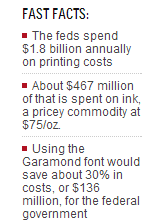
“Ink is two times more expensive than French perfume by volume,” the wise teen told CNN, pointing to the $38 cost of Chanel No. 5 perfume and the $75 an ounce of Hewlett-Packard printer ink will set you back. The feds spend some $1.8 billion in printing costs annually, and have tried double-sided printing and using recycled paper to cut costs. But finding ways to save on annual ink costs of $467 million is a new frontier. Using Garamond would save some 30% on those costs, about $136 million, while if local and state governments followed suit, about $234 million could be cut.

Suvir first conducted his font experiment on a smaller level, looking at the possible savings within his school districts. When he discovered the change could lead to some $21,000 in savings, he took it to the next level and looked at government costs. He submitted his startling findings to the Journal for Emerging Investigators, a journal that publishes research by teens, and the founders of which were blown away by the results.


“We were so impressed,” JEI’s Sarah Fankhauser told CNN. “We really could really see the real-world application in Suvir's paper."

It’s unlikely the feds will take action on Suvir’s say so. A spokesman for the Government Printing Office said efforts towards sustainability have already begun — and as more content goes online, less documents need printing.

"In 1994, we were producing 20,000 copies a day of both the Federal Register and Congressional Record,” Gary Somerset told CNN. “Twenty years later, we produce roughly 2,500 print copies a day.”

Suvir, though, says no matter what happens, some things will need to be printed — and that making a change, even for less documents, remains worthwhile.

"I recognize it's difficult to change someone's behavior. That's the most difficult part,” he told CNN. “I definitely would love to see some actual changes and I'd be happy to go as far as possible to make that change possible.

As you can see, being innovative and thinking outside the box can really pay off. Keep in touch and let us help you maximize the benefits of your printing. Call 877.990.1616 or visit us on the web www.marketinkgroup.com


Thursday, January 30, 2014

The Secret To Retaining All of Your Clients

Just a few short years ago, successful businesses treated their customers the way farmers treat their crops: They were impersonal, transactional relationships. They made sure there was enough water, they kept the weeds out, and when Thanksgiving came around, there were lots of yams to harvest.
Successful companies no longer get away with this kind of behavior.
Customers aren't yams. They need to be listened to, conversed with and treated as individuals.
Today, a much better way of thinking of your customers is like family. Here are three reasons why:
(1) Talk About Yourself Too Much, Your Family Ignores You. What happens if you go home, sit down in the kitchen and talk about your work for fifteen minutes? Chances are everybody else will move to the living room. They don't want a lecture, they want a conversation. The same idea goes for your customers. They don't want to hear about all your new products. They want to have a conversation about how you can help solve their problems.
(2) You Can't Buy a Family. Where did your family come from? It wasn't bought, it was built, probably over a long time. Advertising agencies may tell you they can sell you customers, but they actually give you vegetables. To get a customer, you have to build a relationship. You have follow them on Twitter, comment on their blog and listen to them. BE INVOLVED!
(3) You Should Eat Turkey With Your Family. Your family may be a lot of work, it may drive you nuts sometimes, but your life is better with them in it. You need to invest in your relationship with them. You need to go eat turkey -- or whatever it is you eat -- with them. If you treat them like vegetables, a commodity you tolerate every once in a while, you'll lose them. The same goes for your customers. Spend time with them, communicate with them, invest in relationships with them and they'll be around for a while.

Thursday, January 23, 2014

The Printing Process: Die Cutting

Every morning this week, I’m running a series of guests posts about different printing methods – so if you’ve ever wondered why certain printing methods are best for certain kinds of designs (or cost more than others), this is for you!  You can read the previous installments covering digital printing, engraving, screen printing, letterpress printing with antique type, and foil stamping all right here.  Today, the talented team at Egg Press is here to talk about the technique known as die-cutting, which they use to produce unique shapes, edges, and message windows in greeting cards and other stationery design elements.
What is Die Cutting?
Die-cutting is a process used in many different industries to cut a thin flat material (in our case, paper) into a specific shape using a steel cutting die.  It can be used to punch out a decorative shape or pattern to incorporate within a larger piece, or it can be used to create the main shape of an object by cutting the entire sheet of paper in an distinct/designed way.  More simply put: for us it’s way of making a hole in paper in a desired shape using the same presses that we use for letterpress printing.
Like letterpress, a die-cut element draws attention to the 3D nature of paper and the character of the material itself.  We mostly use die-cutting as a feature – taking an industrial process and turning it into a design element.  As a letterpress print shop, here are some common ways we use die-cutting:
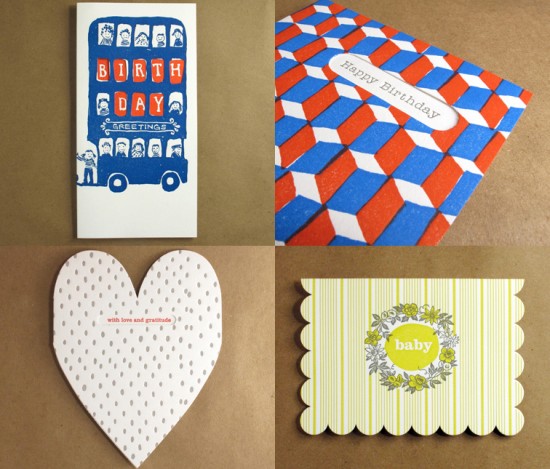
  • to create die-cut windows for messages on greeting cards
  • to create a unique shaped greeting card (examples include heart die-cuts, scallops, mini-paper sculptures)
  • as a design element in one of our new wedding suites
  • to create die-cut coasters, hang tags, and rounded corners on business cards for clients
  • to make the boxes in which our cards are packaged
The Printing Process
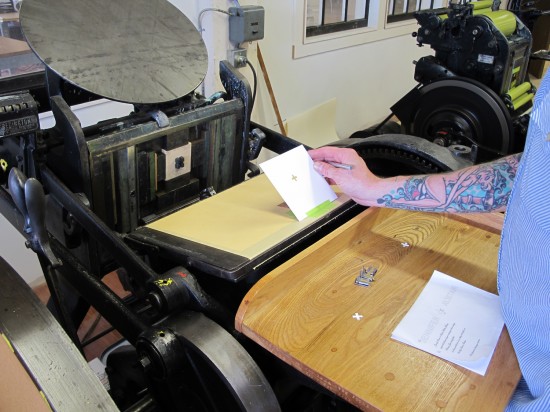
The process of die-cutting is easy for us as letterpress printers, as the set-up is similar to letterpress printing.  Instead of a type-high printing plate we use a type high wood mounted steel cutting die.  The shape of the cutting die is often something we’ve designed and ordered from our local die-makers.  Instead of tympan paper and packing (used to control the impression when printing), we use a sheet of metal on the press bed giving the die a hard surface to cut against.
The first few steps are essentially the same as letterpress printing, although since we’re not using ink we’re always sure to remove the rollers from the press before we start.  We don’t want the dies to damage our rubber rollers!
Next, we attach metal plate/backing onto the press bed by locking the die into the chase and inserting the chase into the press.  Then we’re ready to turn on the press and make a cut.
Pop out the cut shape (paper is still taped to press bed).  Slide your mock-up proof underneath – align your mock up with the cut sample – hold in place.  Make any necessary adjustments, start cutting, and enjoy the confetti!
Tips + Advice
Though die-cutting can produce unique results, it’s not for every print job.  This is why it’s not very commonly used, and why it can be so distinctive.  A die-cut can add a decorative element or a functional component to a design.  For stationery or invitations, creating a die-cut silhouette for your suite may add interest and a vintage feel.  Using a small punch-out within the invitation as a motif can be a nice touch (in this case, a modern feel).  A functional die-cut might be something like a half-moon thumb hole on an open ended envelope, or a notch system in a folded piece.  There are many possibilities for die-cutting, but the medium has limitations.
Complicated shapes or patterns may not work (ask your printer or die-maker).  There is a minimum size for die-cut elements.  The maximum size of the die-cut will depend on the capability of the press you are using.

Paper can affect the outcome – this is something to consider when choosing your paper or choosing to use a die-cut element.  In our experience, thinner paper has less resistance and seems to cut more cleanly while thicker stock can yield mushy edges.  Cotton paper can leave a ragged edge.  Finally, when mailing something with a die-cut element it’s a good policy to mail it in an envelope for protection.  It might not be a good choice for a postcard mailer or rsvp card.

SOURCE: http://ohsobeautifulpaper.com/2012/01/the-printing-process-die-cutting/

If you're still with us, chances are die cutting would be an interesting choice for your company! Marketink can help you decide the best format for your materials. Give us a call to schedule your free 20 minute brainstorming session. 866-245-6723

Thursday, November 21, 2013

Is Print Marketing Still Important?

What we couldn’t have possibly imagined just a decade ago has become a reality: everything has moved online. We shop online, we do our banking online, we play online, and we even socialize online. In addition, research shows that when making buying decisions, the first place people go to for researching their options is the Internet.
Which brings up the question, if everything takes place online these days, and especially if you’re an online business, should you still use printed marketing materials such as brochures as part of your marketing strategy?


Why printed marketing materials are still valuable
The short answer is yes. Marketing is never about just one medium. It’s always a mistake to focus on just one aspect of marketing and to neglect the others. A good marketing campaign utilizes many different mediums to generate many different leads, then nurtures them until they are ready to become customers.
So, while “online” is really hot these days, the physical world still exists, and there are enough potential customers who, after the initial online research, expect to see printed material. These people typically find it difficult to trust a business if it’s completely virtual. They need to know that you have a physical address, a phone number, and that they can see a brochure or other types of printed material before they commit to you.
If you ignore these consumers, you have just lost a segment of the population that could have been interested in your solution.
No doubt, when you plan your marketing budget, you need to pay special attention to online components, including your Web site, your blog and your social media accounts. Ideally, you want to have a great logo, and you want your logo to appear on all online venues (main site, blog header, Twitter background etc.)
To keep your brand highly unique and identifiable, you should also have the same logo appear on your business cards and on any printed marketing materials such as brochures and flyers.


How to create an effective brochure
Now that we’ve established the importance of brochures and of other printed marketing materials, here are a few handy tips for writing and designing an effective brochure:
1. Make it visually appealing. Design is extremely important when it comes to brochures. If the design is boring or cluttered, people won’t bother to read your text. Look for a small business graphic designer who has a lot of experience and can show you samples of their previous work. Better yet, make sure they have positive testimonials on their site, or on a third party site.
2. Focus on benefits rather than on features. Prospects don’t care about your product’s features. They want you to answer the question, “what’s in it for me?” and your brochure needs to be able to answer that question, or it will be tossed!
3. Keep it short. Do you really need a 10-page brochure? Generally, short, catchy brochures with a large font and a clean design are better than long, tiresome, technical brochures.
4. Make it personal. Write your brochure in a direct, conversational tone – as if you are talking with a person face to face. The more personal and direct your tone is, the easier it will be for prospects to connect with your message.
5. Include a call for action. Every marketing material should include a call for action, and this is true for brochures as well. A call for action can be as simple as ending your brochure with the sentence “Need ____? Call today” and your phone number. The idea is to present the pain, your business as the solution, and to encourage the prospect to take immediate action by calling you.
6. Get it printed right. Align yourself with a print partner that understands your needs and goals and that is willing to work with you to help you achieve them by providing with you with professional knowledge and great quality yet cost effective printing options. 
Whether you have a physical location or fully operate online, your small business marketing strategy should include online marketing materials AND printed marketing materials. This combination will make sure you don’t neglect an important segment of your potential market.
If you would like to discuss in more detail your ideas about this or other print marketing materials please call us at 866.245.6723, our team at Marketink is ready to brainstorm with you and help you produce great print collateral to fit within you marketing strategy and budget.


Thursday, November 7, 2013

The Power of a Handwritten Thank You Note and How it Will Help Your Business


Not Just a Thing of the Past
Handwritten thank you notes are not just a thing of the past. While you might not see many these days, the cards you do send or receive will mean more than you’d ever think. Handwritten notes are a powerful way to send a message to a customer to thank them for doing business with your company. They don’t actually take that long to write, and your company will stand out amongst others because of the 5 extra minutes you took to write the note.

Why don’t many companies send handwritten Thank You Notes?