Showing posts with label Planning for Success. Show all posts

Thursday, January 30, 2014

The Secret To Retaining All of Your Clients

Just a few short years ago, successful businesses treated their customers the way farmers treat their crops: They were impersonal, transactional relationships. They made sure there was enough water, they kept the weeds out, and when Thanksgiving came around, there were lots of yams to harvest.
Successful companies no longer get away with this kind of behavior.
Customers aren't yams. They need to be listened to, conversed with and treated as individuals.
Today, a much better way of thinking of your customers is like family. Here are three reasons why:
(1) Talk About Yourself Too Much, Your Family Ignores You. What happens if you go home, sit down in the kitchen and talk about your work for fifteen minutes? Chances are everybody else will move to the living room. They don't want a lecture, they want a conversation. The same idea goes for your customers. They don't want to hear about all your new products. They want to have a conversation about how you can help solve their problems.
(2) You Can't Buy a Family. Where did your family come from? It wasn't bought, it was built, probably over a long time. Advertising agencies may tell you they can sell you customers, but they actually give you vegetables. To get a customer, you have to build a relationship. You have follow them on Twitter, comment on their blog and listen to them. BE INVOLVED!
(3) You Should Eat Turkey With Your Family. Your family may be a lot of work, it may drive you nuts sometimes, but your life is better with them in it. You need to invest in your relationship with them. You need to go eat turkey -- or whatever it is you eat -- with them. If you treat them like vegetables, a commodity you tolerate every once in a while, you'll lose them. The same goes for your customers. Spend time with them, communicate with them, invest in relationships with them and they'll be around for a while.

Thursday, January 23, 2014

The Printing Process: Die Cutting

Every morning this week, I’m running a series of guests posts about different printing methods – so if you’ve ever wondered why certain printing methods are best for certain kinds of designs (or cost more than others), this is for you!  You can read the previous installments covering digital printing, engraving, screen printing, letterpress printing with antique type, and foil stamping all right here.  Today, the talented team at Egg Press is here to talk about the technique known as die-cutting, which they use to produce unique shapes, edges, and message windows in greeting cards and other stationery design elements.
What is Die Cutting?
Die-cutting is a process used in many different industries to cut a thin flat material (in our case, paper) into a specific shape using a steel cutting die.  It can be used to punch out a decorative shape or pattern to incorporate within a larger piece, or it can be used to create the main shape of an object by cutting the entire sheet of paper in an distinct/designed way.  More simply put: for us it’s way of making a hole in paper in a desired shape using the same presses that we use for letterpress printing.
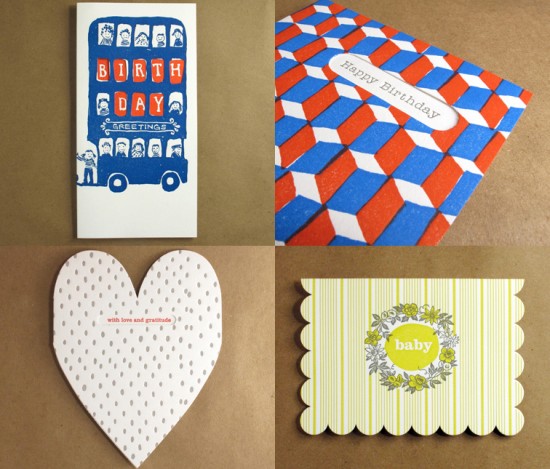
Like letterpress, a die-cut element draws attention to the 3D nature of paper and the character of the material itself.  We mostly use die-cutting as a feature – taking an industrial process and turning it into a design element.  As a letterpress print shop, here are some common ways we use die-cutting:
  • to create die-cut windows for messages on greeting cards
  • to create a unique shaped greeting card (examples include heart die-cuts, scallops, mini-paper sculptures)
  • as a design element in one of our new wedding suites
  • to create die-cut coasters, hang tags, and rounded corners on business cards for clients
  • to make the boxes in which our cards are packaged
The Printing Process
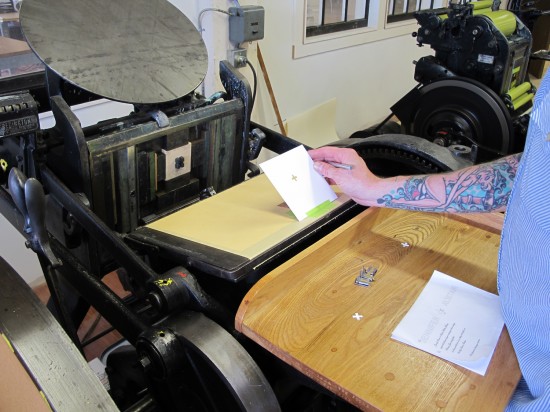
The process of die-cutting is easy for us as letterpress printers, as the set-up is similar to letterpress printing.  Instead of a type-high printing plate we use a type high wood mounted steel cutting die.  The shape of the cutting die is often something we’ve designed and ordered from our local die-makers.  Instead of tympan paper and packing (used to control the impression when printing), we use a sheet of metal on the press bed giving the die a hard surface to cut against.
The first few steps are essentially the same as letterpress printing, although since we’re not using ink we’re always sure to remove the rollers from the press before we start.  We don’t want the dies to damage our rubber rollers!
Next, we attach metal plate/backing onto the press bed by locking the die into the chase and inserting the chase into the press.  Then we’re ready to turn on the press and make a cut.
Pop out the cut shape (paper is still taped to press bed).  Slide your mock-up proof underneath – align your mock up with the cut sample – hold in place.  Make any necessary adjustments, start cutting, and enjoy the confetti!
Tips + Advice
Though die-cutting can produce unique results, it’s not for every print job.  This is why it’s not very commonly used, and why it can be so distinctive.  A die-cut can add a decorative element or a functional component to a design.  For stationery or invitations, creating a die-cut silhouette for your suite may add interest and a vintage feel.  Using a small punch-out within the invitation as a motif can be a nice touch (in this case, a modern feel).  A functional die-cut might be something like a half-moon thumb hole on an open ended envelope, or a notch system in a folded piece.  There are many possibilities for die-cutting, but the medium has limitations.
Complicated shapes or patterns may not work (ask your printer or die-maker).  There is a minimum size for die-cut elements.  The maximum size of the die-cut will depend on the capability of the press you are using.

Paper can affect the outcome – this is something to consider when choosing your paper or choosing to use a die-cut element.  In our experience, thinner paper has less resistance and seems to cut more cleanly while thicker stock can yield mushy edges.  Cotton paper can leave a ragged edge.  Finally, when mailing something with a die-cut element it’s a good policy to mail it in an envelope for protection.  It might not be a good choice for a postcard mailer or rsvp card.

SOURCE: http://ohsobeautifulpaper.com/2012/01/the-printing-process-die-cutting/

If you're still with us, chances are die cutting would be an interesting choice for your company! Marketink can help you decide the best format for your materials. Give us a call to schedule your free 20 minute brainstorming session. 866-245-6723

Wednesday, November 27, 2013

Planning for a Successful Small Business Saturday


With consumers tightening their purse strings, small business across the nation have a much harder job acquiring sales.  Although the general feeling is that this year will be more successful than last, there’s still work to be done.  Small Business Saturday, created by American Express, is all about encouraging consumers to shop locally and support their community.
Small Business Saturday is celebrating it’s fourth year and is truly a salute to the many local small businesses that make this nation great.  This year Small Business Saturday will take place on November 30th.  Retailers are already beginning to prepare for what they hope will be a great start to the holiday shopping season. The tricky part about it, is that Small Business Saturday is only once a year so it’s important that you do it right to keep customers in that “shop local” mindset all year long. Here are a few ways in which you can do just that.
Get the word out!
Due to a late Thanksgiving and early start to Hanukah, retailers are getting a much earlier start to their holiday sales promotions than previous years.  Small Business Saturday may not be as well known as Cyber Monday, but is gaining in popularity as more and more people promote it.  Small business owners are seeing the benefits of joining this initiative to boost the local economy.
There are several ways retailers can get the word out with custom print products.  
Some small business owners may choose to hang banners on their storefronts to announce the coming event. Others use additional marketing tools like save the date magnets or use promotional postcards to encourage holiday shoppers to show their support for the small business owner.

Gifts for all!

Small businesses are not only offering discounts on Small Business Saturday, they are celebrating the season by presenting their customers with small promotional gifts.  Everyone loves a free promo whether it’s a small sample of peppermint hot chocolate or custom notepads featuring your business logo.  
Other small retailers may opt to present their customers with promotional coupons for use at a later date to encourage repeat business.  It’s not about just getting consumers to support your business that one day, but throughout the year.  It’s really about building relationships which is what most small businesses are made of.

Celebrate with the Community

This year American Express has formed a new program asking community stores to band together and create special events for shoppers.  These Neighborhood Champions have arranged events such as parades, treasure hunts through stores and giveaways.  Local community leaders are promoting their town’s Small Business Saturday on Social Media and radio.  Small business owners understand that there is strength in numbers and combining their efforts makes for a more successful shopping event.
And…Don’t forget to:

Deck The Halls!

If you’ve ever been to the mall at Christmas time – and who hasn’t?!- you can’t escape the smells and sounds of the holidays.  Christmas carols play in every store and windows are adorned with wreaths and holiday lights.  It’s a winter wonderland, Santa’s even there to hear your Christmas wish.
Small businesses have to take a note from big business retailers and transform their stores with dazzling seasonal decorations.  Cafes, bakeries and restaurants should take the time to add holiday inspired drinks and pastries to their menu.  Small businesses need to get festive and inspire the mood of the holidays in their customers.
Retailers are optimistic that this holiday shopping season will be more profitable than the last.  With initiatives like Small Business Saturday, small business owners are geared up for a successful season that will drive new traffic to their stores and help them gain new customers that will keep coming back throughout the year.

We know that running a small business is a labor of love.  We wish everyone an amazing holiday season.  Let us know how your business celebrated Small Business Saturday.