Showing posts with label direct mailer. Show all posts

Thursday, January 23, 2014

The Printing Process: Die Cutting

Every morning this week, I’m running a series of guests posts about different printing methods – so if you’ve ever wondered why certain printing methods are best for certain kinds of designs (or cost more than others), this is for you!  You can read the previous installments covering digital printing, engraving, screen printing, letterpress printing with antique type, and foil stamping all right here.  Today, the talented team at Egg Press is here to talk about the technique known as die-cutting, which they use to produce unique shapes, edges, and message windows in greeting cards and other stationery design elements.
What is Die Cutting?
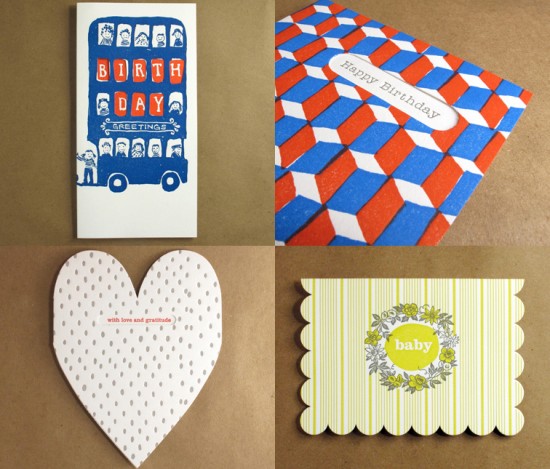
Die-cutting is a process used in many different industries to cut a thin flat material (in our case, paper) into a specific shape using a steel cutting die.  It can be used to punch out a decorative shape or pattern to incorporate within a larger piece, or it can be used to create the main shape of an object by cutting the entire sheet of paper in an distinct/designed way.  More simply put: for us it’s way of making a hole in paper in a desired shape using the same presses that we use for letterpress printing.
Like letterpress, a die-cut element draws attention to the 3D nature of paper and the character of the material itself.  We mostly use die-cutting as a feature – taking an industrial process and turning it into a design element.  As a letterpress print shop, here are some common ways we use die-cutting:
  • to create die-cut windows for messages on greeting cards
  • to create a unique shaped greeting card (examples include heart die-cuts, scallops, mini-paper sculptures)
  • as a design element in one of our new wedding suites
  • to create die-cut coasters, hang tags, and rounded corners on business cards for clients
  • to make the boxes in which our cards are packaged
The Printing Process
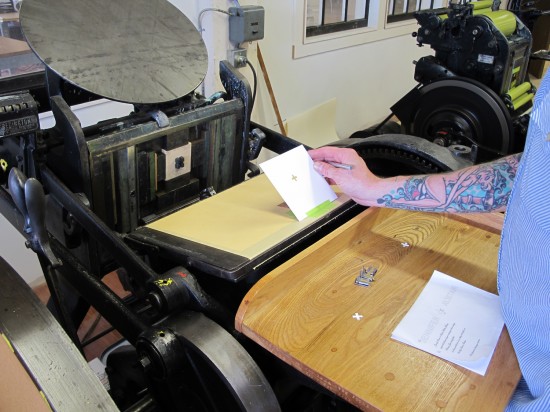
The process of die-cutting is easy for us as letterpress printers, as the set-up is similar to letterpress printing.  Instead of a type-high printing plate we use a type high wood mounted steel cutting die.  The shape of the cutting die is often something we’ve designed and ordered from our local die-makers.  Instead of tympan paper and packing (used to control the impression when printing), we use a sheet of metal on the press bed giving the die a hard surface to cut against.
The first few steps are essentially the same as letterpress printing, although since we’re not using ink we’re always sure to remove the rollers from the press before we start.  We don’t want the dies to damage our rubber rollers!
Next, we attach metal plate/backing onto the press bed by locking the die into the chase and inserting the chase into the press.  Then we’re ready to turn on the press and make a cut.
Pop out the cut shape (paper is still taped to press bed).  Slide your mock-up proof underneath – align your mock up with the cut sample – hold in place.  Make any necessary adjustments, start cutting, and enjoy the confetti!
Tips + Advice
Though die-cutting can produce unique results, it’s not for every print job.  This is why it’s not very commonly used, and why it can be so distinctive.  A die-cut can add a decorative element or a functional component to a design.  For stationery or invitations, creating a die-cut silhouette for your suite may add interest and a vintage feel.  Using a small punch-out within the invitation as a motif can be a nice touch (in this case, a modern feel).  A functional die-cut might be something like a half-moon thumb hole on an open ended envelope, or a notch system in a folded piece.  There are many possibilities for die-cutting, but the medium has limitations.
Complicated shapes or patterns may not work (ask your printer or die-maker).  There is a minimum size for die-cut elements.  The maximum size of the die-cut will depend on the capability of the press you are using.

Paper can affect the outcome – this is something to consider when choosing your paper or choosing to use a die-cut element.  In our experience, thinner paper has less resistance and seems to cut more cleanly while thicker stock can yield mushy edges.  Cotton paper can leave a ragged edge.  Finally, when mailing something with a die-cut element it’s a good policy to mail it in an envelope for protection.  It might not be a good choice for a postcard mailer or rsvp card.

SOURCE: http://ohsobeautifulpaper.com/2012/01/the-printing-process-die-cutting/

If you're still with us, chances are die cutting would be an interesting choice for your company! Marketink can help you decide the best format for your materials. Give us a call to schedule your free 20 minute brainstorming session. 866-245-6723

Thursday, December 12, 2013

5 Tips for Making the Best Holiday Mailers this Season

The holidays are a special time. If you have not yet started planning a direct mail marketing campaign, you have best be getting a move on! The holidays are a great time for you to do some promotional activities for your brand and product offering. They’re also a time when customers are really looking to purchase items. Thus, it’s important to make sure that you get a fair share of that holiday market.
Before you start sending out the usual holiday postcards and catalogues, it is important to note that you are not the only company who will be sending out mailers to their prospective clients. Other companies would also like to promote their products and/or services and secure their share of the holiday market. That being said, it is important to make your direct mail package stand out. Here are a few ways you can achieve terrific holiday direct mailers.
Holiday Design
Enlist the help of a few elves from a commercial printing company. They can greatly help in terms of design to make your mailer look appropriate for the occasion. Also, they offer a variety of services that speed up the packaging process and ensure that your mailer has all the right components just in time for the holidays.
Dimensional Mailers
As stated earlier, yours won’t be the only company that will be sending out direct mail to clients. When your potential client finds a stack of ad mailers in his mailbox, their tendency is unfortunately to just chuck it out. But if your mailer has bulk or is three-dimensional, your customer will be curious about what it is. That’s the opening you need. Dimensional mailers naturally cost more but the profits they generate make them worth it. Most direct mail companies offer holiday discounts which could greatly help you in terms of costs.
Promotions
Attract them with discounts, freebies or special deals. Create a sense of anticipation by adding special contest prizes which they can win if they avail of your product or service.
Reward Your Loyal Customers
Tis the season for giving. Reward your loyal customers with discounts, freebies or exclusive deals. For example, if you have a customer who purchased an mp3 player last year, offer them a huge discount on this year’s latest model. If you sell clothing, offer a discount on your most popular pieces or on next season’s collection. This will make your customers feel valued and will ensure that they will be your clients for a long time. These can also help bring back clients who looked elsewhere last year. 


QR Codes
The advent of QR codes present many retail possibilities. You can instruct your printing co. to include QR codes in your mailer representing a free small product that your clients can claim when they scan and send it to you. You can also arrange a scavenger hunt with these QR codes. Have your clients scan as many QR codes as possible. When they rack up a certain number of points, reward them with prizes which may include freebies, discounts, tickets, etc. This will make shopping more fun and exciting for your customer base.
Here at Marketink we are happy to provide you with free 20 minute marketing consultations. If you’re looking for some help brainstorming, feel free to schedule your appointment. http://www.marketinkgroup.com Happy holidays!


Thursday, November 21, 2013

Is Print Marketing Still Important?

What we couldn’t have possibly imagined just a decade ago has become a reality: everything has moved online. We shop online, we do our banking online, we play online, and we even socialize online. In addition, research shows that when making buying decisions, the first place people go to for researching their options is the Internet.
Which brings up the question, if everything takes place online these days, and especially if you’re an online business, should you still use printed marketing materials such as brochures as part of your marketing strategy?


Why printed marketing materials are still valuable
The short answer is yes. Marketing is never about just one medium. It’s always a mistake to focus on just one aspect of marketing and to neglect the others. A good marketing campaign utilizes many different mediums to generate many different leads, then nurtures them until they are ready to become customers.
So, while “online” is really hot these days, the physical world still exists, and there are enough potential customers who, after the initial online research, expect to see printed material. These people typically find it difficult to trust a business if it’s completely virtual. They need to know that you have a physical address, a phone number, and that they can see a brochure or other types of printed material before they commit to you.
If you ignore these consumers, you have just lost a segment of the population that could have been interested in your solution.
No doubt, when you plan your marketing budget, you need to pay special attention to online components, including your Web site, your blog and your social media accounts. Ideally, you want to have a great logo, and you want your logo to appear on all online venues (main site, blog header, Twitter background etc.)
To keep your brand highly unique and identifiable, you should also have the same logo appear on your business cards and on any printed marketing materials such as brochures and flyers.


How to create an effective brochure
Now that we’ve established the importance of brochures and of other printed marketing materials, here are a few handy tips for writing and designing an effective brochure:
1. Make it visually appealing. Design is extremely important when it comes to brochures. If the design is boring or cluttered, people won’t bother to read your text. Look for a small business graphic designer who has a lot of experience and can show you samples of their previous work. Better yet, make sure they have positive testimonials on their site, or on a third party site.
2. Focus on benefits rather than on features. Prospects don’t care about your product’s features. They want you to answer the question, “what’s in it for me?” and your brochure needs to be able to answer that question, or it will be tossed!
3. Keep it short. Do you really need a 10-page brochure? Generally, short, catchy brochures with a large font and a clean design are better than long, tiresome, technical brochures.
4. Make it personal. Write your brochure in a direct, conversational tone – as if you are talking with a person face to face. The more personal and direct your tone is, the easier it will be for prospects to connect with your message.
5. Include a call for action. Every marketing material should include a call for action, and this is true for brochures as well. A call for action can be as simple as ending your brochure with the sentence “Need ____? Call today” and your phone number. The idea is to present the pain, your business as the solution, and to encourage the prospect to take immediate action by calling you.
6. Get it printed right. Align yourself with a print partner that understands your needs and goals and that is willing to work with you to help you achieve them by providing with you with professional knowledge and great quality yet cost effective printing options. 
Whether you have a physical location or fully operate online, your small business marketing strategy should include online marketing materials AND printed marketing materials. This combination will make sure you don’t neglect an important segment of your potential market.
If you would like to discuss in more detail your ideas about this or other print marketing materials please call us at 866.245.6723, our team at Marketink is ready to brainstorm with you and help you produce great print collateral to fit within you marketing strategy and budget.


Thursday, November 7, 2013

The Power of a Handwritten Thank You Note and How it Will Help Your Business


Not Just a Thing of the Past
Handwritten thank you notes are not just a thing of the past. While you might not see many these days, the cards you do send or receive will mean more than you’d ever think. Handwritten notes are a powerful way to send a message to a customer to thank them for doing business with your company. They don’t actually take that long to write, and your company will stand out amongst others because of the 5 extra minutes you took to write the note.

Why don’t many companies send handwritten Thank You Notes?

Thursday, October 10, 2013

Unlocking the Code - QR Code Success for Marketers

A QR code is basically a barcode in a square shape. (Without bars, ironically). It is scanned by a smartphone. It could direct someone to a website, an image, a text message or, even, a phone number. (That’s totally up to the QR code’s creator). For marketers, a QR code allows you to get smartphone users to call you without forcing them to actually type in a phone number or URL.

QR codes reduce friction.

How Popular Are They, Really?

Thursday, October 3, 2013

Hello (INSERT NAME) Variable Data Printing Will Get YOU Results


What is "Variable Data Printing"?
Variable data printing (also known as one-to-one marketing or personalized printing) offers customized, targeted encounters with prospective customers, placing a powerful marketing tool into the hands of even small organizations. VDP has been shown to dramatically increase response rates while reducing overall printing costs (due to shorter, more targeted print runs as opposed to traditional "shotgun" campaigns).
It is an ideal solution for

Thursday, September 12, 2013

How To Measure the Success of Your Direct Mailer Marketing Efforts

If you send out 1500 direct mailers to potential customers, you need ways of knowing how many of them interacted with your direct mail in some way, and how many made purchases because of your campaign. That way, you can make adjustments to your future direct mailer campaigns and enjoy increased sales. Here are some tips on how to measure your direct mailer marketing efforts.